


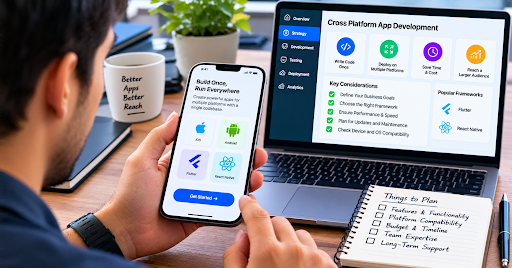
Somewhere in almost every app project, there’s a meeting where someone asks the question that quietly decides the next six months: do we build for iPhone and Android separately, or do it once and ship to both? It sounds like a technical question. It’s really a budget question, a timeline question, and a “how much do we trust this product to work” question all wrapped into one. A reliable Cross Platform app Development service can make that decision far less painful, but only if the business walking in understands what it’s actually signing up for.
Cross-platform development has matured a lot. A few years ago it carried a reputation for sluggish performance and clunky interfaces, the kind of apps that felt slightly off no matter how polished the screens looked. That reputation isn’t entirely fair anymore, but it isn’t entirely undeserved either. The honest picture sits somewhere in the middle, and knowing where your own project falls on that spectrum is the whole game.
What “Cross-Platform” Actually Means in Practice
At its simplest, a cross-platform app is built from a single codebase that runs on multiple operating systems, usually iOS and Android, sometimes web and desktop too. Instead of two separate teams writing two separate apps in Swift and Kotlin, one team writes the core logic once and a framework translates it for each platform.
The frameworks doing most of that translating today are Flutter, React Native, and Xamarin’s successor .NET MAUI, with Kotlin Multiplatform gaining ground among teams that want to share business logic while keeping native interfaces. Each takes a different approach. Flutter draws its own interface using Google’s Skia and Impeller rendering engines, which gives developers pixel-level control. React Native uses JavaScript to drive actual native components, which tends to feel more familiar on each platform. Neither is universally better, and anyone who tells you otherwise is probably selling one of them.
The Real Appeal: Speed to Market and Budget Efficiency
The most obvious benefit is cost. Maintaining one codebase instead of two means fewer developers, shorter timelines, and a smaller bill, often cutting development effort by thirty to forty percent compared to building two fully native apps. For a startup trying to validate an idea before money runs out, that difference isn’t a nice-to-have. It can decide whether the product launches at all.
Speed matters just as much. Launching on both stores at the same time means reaching your entire potential audience from day one instead of picking a platform and watching half your market go to a competitor in the meantime. Updates also roll out together, so a bug fix or new feature shows up for everyone at once rather than creating the awkward situation where Android users get something iPhone users are still waiting on.
Where Cross-Platform Falls Short
Pretending there are no tradeoffs would be doing readers a disservice. Performance is the biggest one. Native apps talk directly to a device’s hardware, and that directness shows up in animation smoothness, battery efficiency, and responsiveness under heavy load. For most business apps — booking tools, ecommerce, loyalty programs, internal dashboards — cross-platform performance is more than good enough. For graphically intense games, complex AR experiences, or apps that process large amounts of data on-device, it can become a real limitation.
Access to the newest platform features is another sore spot. When Apple or Google releases a new capability, native developers can use it on day one. Cross-platform frameworks usually need weeks or months to catch up with official support, which matters if your product’s whole pitch depends on being first to use something new.
Then there’s the matter of platform conventions. iOS and Android users expect different navigation patterns, different gestures, different visual language. A cross-platform app that ignores these differences feels subtly wrong to both audiences, and users can’t always articulate why, they just stop using it.
Questions to Settle Before Choosing an Approach
A few honest questions will save a lot of regret later.
First, what does the app actually need to do? A product built around standard screens, forms, lists, and payments is a natural fit for cross-platform. A product that leans heavily on device-specific hardware like advanced camera processing, Bluetooth connectivity with specialized peripherals, or background location tracking needs a closer look, because those features sometimes require writing native code anyway.
Second, where do your users actually live? If analytics show eighty percent of your target audience uses iPhones, building for Android immediately may be wasted effort. Starting native on one platform and expanding later can sometimes make more sense than forcing a cross-platform build on a market that doesn’t need it.
Third, how long will this product live? A short-lived campaign app has different needs than a core product expected to evolve for a decade. Long-term maintenance costs, framework stability, and developer availability all matter more the longer the horizon stretches.
Choosing the Right Framework
Framework choice shapes everything downstream, and it shouldn’t be decided by whichever one a developer happens to prefer.
Flutter works well for products where a custom, highly branded interface matters, and where consistent visuals across platforms are a priority. Its widget system makes complex animations relatively straightforward, and its community has grown quickly. The tradeoff is that it uses the Dart language, which is less common than JavaScript, so hiring can take a bit more effort.
React Native suits teams already working in JavaScript or TypeScript, and benefits from a massive ecosystem of libraries and an enormous talent pool. Companies like Meta, Shopify, and Microsoft have shipped serious products with it. The tradeoff is that complex native integrations sometimes require bridging code that adds maintenance overhead.
Kotlin Multiplatform appeals to teams who want native interfaces on each platform while sharing the underlying business logic, which can give a more authentic feel at the cost of more development effort than a fully shared interface.
None of these is a wrong choice in the abstract. They’re only wrong when mismatched with a project’s actual requirements and a team’s actual skills.
Planning the Build Properly
Many businesses wonder how to build a cross-platform mobile app without wasting months on avoidable mistakes, and the answer almost always starts before any code gets written. Defining the core user problem, mapping the essential features for a first release, choosing a framework based on real requirements, designing with both platforms’ conventions in mind, and setting up automated testing across actual devices are the steps that separate smooth projects from painful ones.
Scope discipline matters more than people expect. The temptation to cram every imaginable feature into version one is strong, and it’s the single most common reason app projects blow past their budgets. A focused minimum viable product that does one thing well teaches a business far more than a sprawling build nobody has validated yet.
Design Considerations That Get Overlooked
Good cross-platform design isn’t about making iOS and Android look identical. It’s about deciding deliberately where consistency helps and where platform-specific behavior matters more. Navigation is a classic example: iOS users expect swipe-back gestures and tab bars at the bottom, while Android users are used to a system back button and sometimes a navigation drawer. Forcing one pattern onto the other platform creates friction people feel without naming.
Typography, spacing, haptic feedback, and even how buttons respond to touch all carry platform expectations. The best cross-platform products respect these conventions where it counts while still maintaining a coherent brand identity, which takes more design thought than simply stretching one layout across two operating systems.
Testing Is Where Projects Quietly Succeed or Fail
One codebase doesn’t mean one set of behaviors. The same code can behave differently across operating system versions, screen sizes, manufacturer customizations, and hardware capabilities. Android’s fragmentation alone, with thousands of device models running different OS versions, creates a testing surface that surprises teams coming from a single-platform background.
Real-device testing matters more than emulators for catching problems that only show up on actual hardware, like performance dips on lower-end phones or layout glitches on unusual screen ratios. Budgeting properly for quality assurance, rather than treating it as an afterthought squeezed in before launch, is one of the clearest signals of a team that’s done this before.
Security and Compliance Can’t Be Delegated to the Framework
A framework doesn’t make an app secure on its own. Data encryption, secure authentication, safe API communication, and proper storage of sensitive information all still require deliberate engineering, and the specifics differ between platforms. Apps handling payments, health information, or personal data also need to meet regulations like GDPR, CCPA, PCI DSS, or HIPAA depending on the industry and region.
Third-party libraries, which cross-platform projects rely on heavily, introduce their own risks. An outdated or poorly maintained package can open a vulnerability that has nothing to do with your own code, which is why dependency management and regular security audits belong in the plan from the beginning, not just after something goes wrong.
Maintenance Costs Don’t End at Launch
Launching is closer to the starting line than the finish. Operating systems update every year, frameworks release new versions, third-party services change their APIs, and app store policies shift. A cross-platform app needs ongoing attention to stay compatible with all of it, and budgeting roughly fifteen to twenty percent of the initial development cost per year for maintenance is a reasonable rule of thumb.
Framework updates deserve particular attention. A major version upgrade in Flutter or React Native can require meaningful refactoring, and falling several versions behind makes eventual upgrades far more painful than staying reasonably current along the way.
Choosing a Development Partner Wisely
The framework matters less than the team using it. A strong development partner will ask uncomfortable questions about your goals before recommending a technology, will show real examples of shipped cross-platform products rather than only polished mockups, and will be honest about where cross-platform won’t serve your project well.
Red flags include teams that recommend the same framework for every project regardless of requirements, vague answers about testing and maintenance, and reluctance to explain how they’d handle features requiring native code. Asking to speak with past clients about how a project went after launch, not just during development, reveals far more than a portfolio ever will.
When Native Still Makes More Sense
Cross-platform isn’t always the answer, and acknowledging that is part of making a good decision. Apps depending on cutting-edge hardware features, demanding maximum performance, or targeting a single platform with a deeply tailored experience often justify the extra cost of native development. Premium consumer products where the feel of the interface is the product itself sometimes fall into this category too.
The smartest businesses treat this as a decision about fit rather than ideology. Plenty of successful companies run a hybrid strategy, using cross-platform for most of the app while writing native modules for the handful of features that truly need them.
Where This Leaves You
Developing a cross-platform app is neither a shortcut nor a compromise when it’s done for the right reasons. It’s a tradeoff, and a good one for a lot of businesses, particularly those prioritizing speed to market, controlled budgets, and consistent experiences across devices. The businesses that regret the choice tend to be the ones who made it for the wrong reason, usually cost alone, without checking whether the product’s actual requirements fit what the approach does well.
Get clear on what the app needs to do, who it’s for, and how long it needs to last. Choose a framework that matches those answers instead of a trend. Budget honestly for testing and maintenance. Do that, and cross-platform development stops being a gamble and becomes what it was always meant to be: a practical way to reach more people with less waste.
Written by
TrendingStage Editorial Team
Technology, Lifestyle, Entertainment & Trending News
View all articles by the team →